Jaguar Jewelry
History of Emeralds
Formation of Emeralds
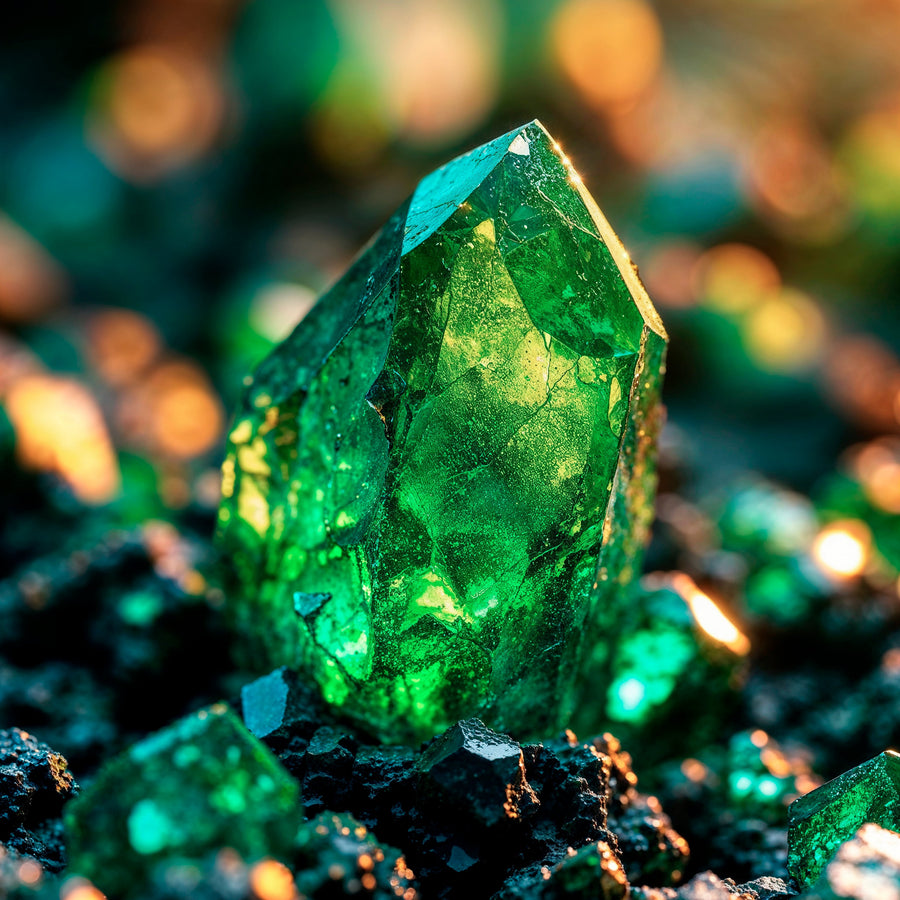
To understand the value of an emerald, we must first understand the extraordinary physical and chemical coincidence required for its birth. The emerald is a variety of the mineral beryl. Its basic chemical formula is beryllium aluminum silicate ($Be_3Al_2(SiO_3)_6$). In its pure state, beryl is completely colorless (known as goshenite). However, when nature introduces microscopic traces of chromium and vanadium into the crystallization lattice, the mineral transforms, acquiring its legendary green color.
The Conflict of Elements
Geologically speaking, the formation of an emerald is an almost statistical impossibility. Beryl is a light element concentrated in the Earth's upper crust, associated with granitic magmas. In contrast, chromium and vanadium are heavy elements found deep within the Earth's mantle, associated with ultramafic rocks. In most parts of the planet (such as Zambia or Brazil), emeralds formed when hot magmatic pegmatites came into forceful contact with mantle rocks. This violent process injects iron into the gem, which gives it a bluish tint and dulls its natural fluorescence.
Colombia's Hydrothermal Miracle
Colombian emeralds are unique in the world because they were not formed by magmatic processes. Millions of years ago, during the formation of the Andes Mountains (Cretaceous and Paleogene periods), intense tectonic pressures fractured deep layers of sedimentary rocks known as black shales.
Saline, hydrothermal fluids at relatively low temperatures (between 250 °C and 400 °C) circulated through these faults, dissolving the beryllium, chromium, and vanadium present in the shales. As they slowly cooled in calcite and pyrite cavities, these fluids crystallized the purest emeralds on the planet. Being a purely sedimentary environment, it is almost entirely devoid of iron. The absence of iron allows chromium and vanadium to express a pure ionic green, giving the gem a natural fluorescence that absorbs light and reflects it with an unparalleled internal brilliance: the mythical gota de aceite (drop of oil) effect.
History of Emeralds in Colombia
The history of the Colombian emerald is an epic that intertwines the sacred devotion of pre-Hispanic cultures, the greed of European empires, and the consolidation of a modern luxury industry.
The Sacred Pre-Columbian Legacy
Centuries before the arrival of Europeans, the territory we now know as the Eastern (Chivor/Somondoco) and Western (Muzo/Coscuez) emerald belts was under the dominion of complex indigenous societies. For the great Muisca confederation, the emerald was not a commodity for exchange, but an object of profound spiritual value. It represented Chía (the Moon) and the fertility of the earth.
The Muiscas extracted gems in a rudimentary way during the rainy season, using hardwood sticks and water channels to remove softened rock. These stones were carved and offered to the gods in sacred lagoons (such as Guatavita and Siecha) through tunjos (votive figurines of gold and emerald). To the west, the indomitable tribe of the Muzos extracted gems for ritual and commercial purposes, establishing a barter network that carried Colombian emeralds to the cultures of Mesoamerica (Mayans and Aztecs).
The Conquest and the Colonial Monopoly
In 1537, the Spanish conquistador Gonzalo Jiménez de Quesada observed with astonishment the intensely green stones possessed by the natives in the Cundiboyacense highlands. This unleashed a frantic search. That same year, they located the Somondoco (Chivor) mines. However, subduing the Muzos required more than twenty years of bloody wars due to the fierce indigenous resistance, until Captain Luis Lanchero founded the city of Santísima Trinidad de los Muzos in 1559.
The Spanish Crown declared emeralds a royal monopoly (Real de Minas). Forced indigenous labor, and later the labor of African slaves, transformed Muzo into the most lucrative gem mine in the Spanish Empire. The galleons of the Spanish treasure fleet, like the famous Nuestra Señora de Atocha (sunk in 1622), sailed from Cartagena loaded with thousands of carats bound for Seville.
From the "Green War" to Sustainable High Jewelry
After Colombia's independence in 1810, control of the mines passed into the hands of the new Republic, which alternated periods of privatization and state abandonment. In the mid-20th century, the discovery of new deposits and the lack of state regulation unleashed a period of internal violence known as the "Green War" (1960s to 1980s), where local clans fought fiercely for control of the mining territories of Muzo and Coscuez.
This dark chapter came to an end in the early 1990s with the signing of peace agreements led by the community itself and the Church. Today, emerald mining in Colombia is experiencing an era of formalization and technification. Large multinationals and local investors have transformed dangerous tunnels into cutting-edge sustainable mining operations, with strict standards of traceability, social, and environmental responsibility, ensuring that every gem that reaches international high jewelry is conflict-free.
A Unique Reputation in the World
Although Colombia represents the pinnacle of gemological quality, humanity's fascination with emeralds is a global story that began thousands of years ago in the deserts of the Old World.
Cleopatra's Mines and Antiquity
The oldest record of emerald mining takes us to Upper Egypt, near the Red Sea, in the Wadi Sikait deposits. Exploited since 1500 BC (or earlier), these mines were historically named "Cleopatra's Mines", due to the Egyptian queen's obsession with this gem, which she used not only as a monarchical ornament but also as a diplomatic gift with her effigy engraved.
These ancient emeralds were, by current standards, of low quality: opaque, pale, and full of fractures. However, for the Roman Empire, they were the ultimate luxury. Pliny the Elder, in his encyclopedia Naturalis Historia (1st Century AD), wrote that "there is no color more pleasing to the eye than the green of the emerald", and described how gem engravers rested their eyes by gazing at these stones. During the Middle Ages, the only known European deposits were the Habachtal mines (in the Austrian Alps), whose stones were small and scarce.
The Global Clash: The Rise of the Gunpowder Empires
The discovery of America in the 16th century changed the history of global jewelry forever. When Colombian emeralds arrived in Europe, their size, transparency, and color were so infinitely superior to those from Egypt and Austria that the latter were immediately abandoned.
Ironically, the final destination of the best Colombian emeralds extracted by the Spanish was not Europe, but East Asia. Through dynamic land and sea trade networks, the gems crossed the Mediterranean to supply the three great Gunpowder Empires: the Ottoman Empire (Turkey), the Safavid Empire (Persia/Iran), and the Mughal Empire (India).
The Mughal emperors developed an almost mystical devotion to Colombian emeralds. They had intricate floral motifs and verses from the Quran carved into them, using them as protective amulets. One of the most famous pieces in the world is the Mogul Mughal Emerald (a 217.80-carat Colombian crystal carved in 1695). The treasures of the sultans in Topkapi Palace in Istanbul still guard daggers and imperial thrones studded with thousands of carats of Andean origin.
The Current Gemological Map
From the 20th century onwards, the world map of emeralds expanded considerably with the discovery of new and important deposits:
- Zambia (Kafubu District): Discovered in the mid-20th century, it is now the world's second-largest producer. Its emeralds are formed in talc-schist rocks, which gives them a high iron content, imparting a deep blue-green color and great clarity.
- Brazil (Minas Gerais and Bahia): A consistent producer of commercial emeralds, mostly discovered from the 1970s onwards in pegmatite environments.
- Afghanistan and Pakistan (Panjshir and Swat Valleys): Produce emeralds of exceptional color quality that rival Colombian ones, although large-scale extraction is severely limited by the geopolitical instability of the region.
Despite this diversified global supply, major auction houses like Christie's and Sotheby's and high jewelry firms from Place Vendôme in Paris continue to list the original Colombian emerald as the absolute gold standard for global collecting.